
The Access Line to AI Prosperity: The Public Equity Model for the AI Boom
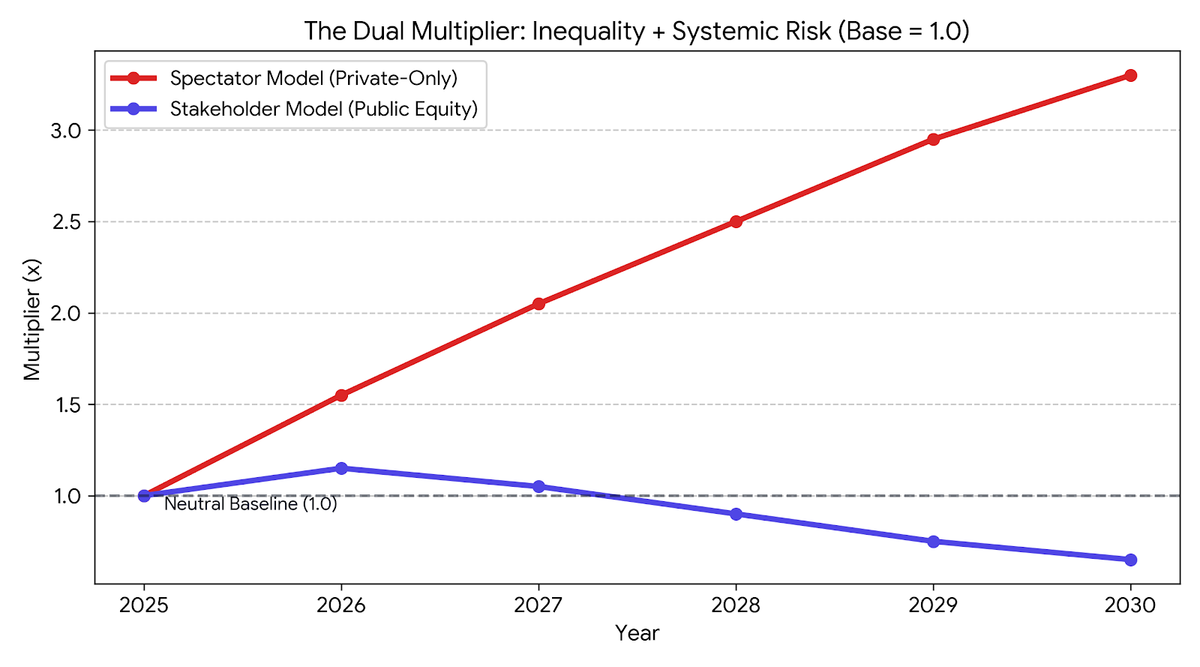
By treating public funds as an "access line" for investment and taking equity stakes through voluntary mechanisms like taxpayer checkoffs, we turn citizens into indirect shareholders. This derisks both inequality and systemic risk without slowing private innovation.
The Inversion at a Glance
- The Structural Pivot: Shift the public sector's role from reactive regulator to proactive equity participant via voluntary, citizen-directed funding mechanisms.
- The Mechanism: Utilize voluntary tax checkoffs (capped at $10/year) to capitalize public venture funds that take minority equity stakes in proven AI infrastructure.
- The Alignment: Private capital continues to drive speed at full throttle. Public capital rides in a parallel lane to capture shared dividends and dilute systemic exposure.
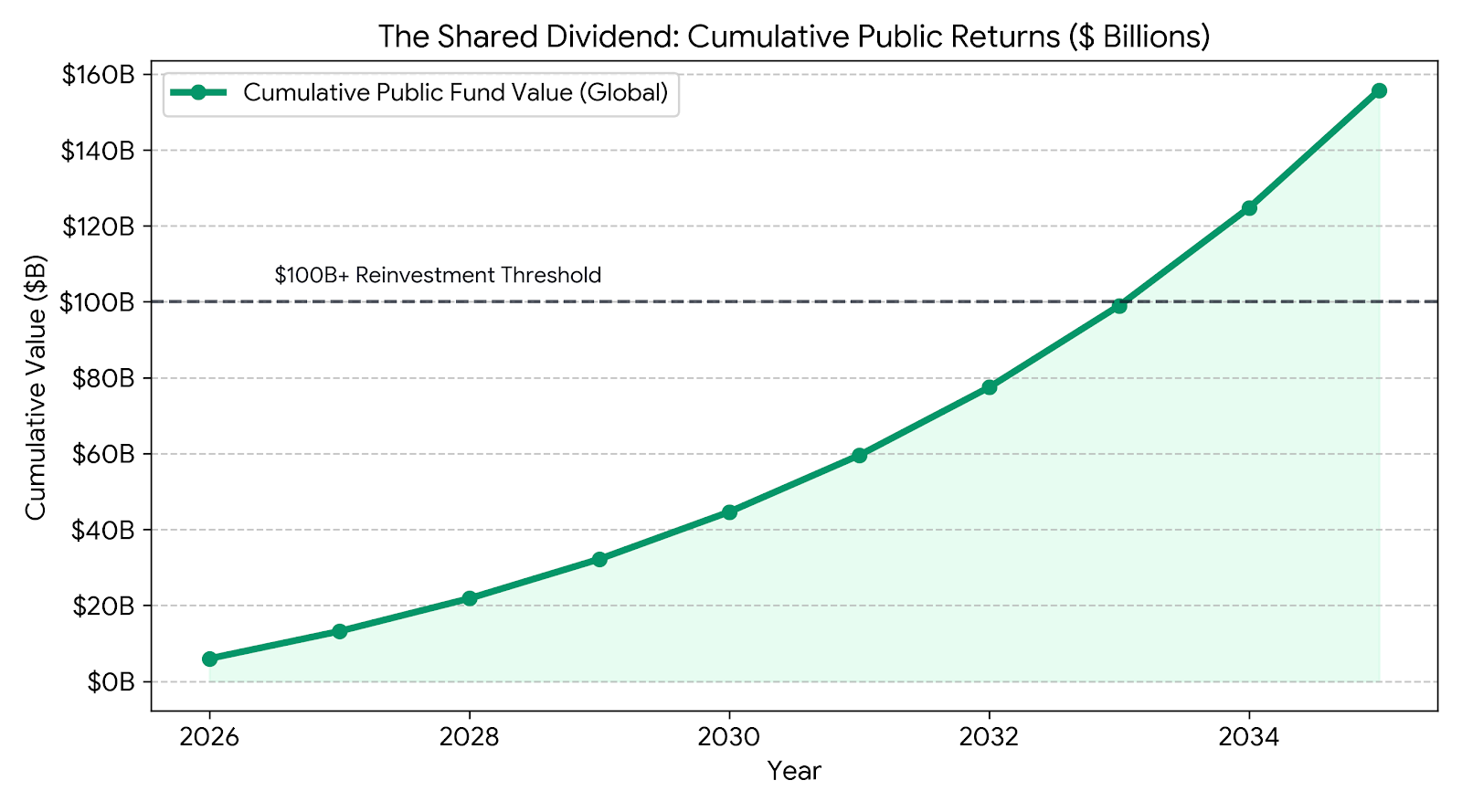
- The Modeled Result: Over $100B+ in cumulative public returns by 2030, reducing AI-driven inequality gaps by 20% to 30% and lowering macroeconomic fragility through diversified public stakes.
Part 1: The Ugly Truth (Inequality & Systemic Risk)
AI's explosive growth is undeniable. Morgan Stanley estimates nearly $3 trillion in AI-related infrastructure investment will flow through the global economy by 2028, with UBS projecting $570 billion in 2026 alone.
But this capital is highly concentrated. Big Tech hyperscalers (Microsoft, Amazon, Google) account for 70% to 80% of current spending. Meanwhile, private investors (SoftBank, Nvidia, Sequoia) dominate the funding rounds for frontier labs like OpenAI (recently valued at $110 billion).
The ugly truth has two sides: First, private AI funding is an "exclusive access line"—derisking the upside for a few while externalizing the economic volatility to society. Second, the concentration of trillions in a handful of players introduces outsized systemic risk. S&P Global warns that debt-fueled AI capex could lead to devaluation if monetization lags, triggering financial crises, bank exposure, and cascading failures that disproportionately hit the bottom 90%.
Simultaneously, we face a "growing divide." The UN Development Program’s 2025 report explicitly warns that AI adoption risks deepening global inequalities. Labor analyses from institutions like Brookings demonstrate that automation does not impact all groups equally; lower-wage workers face significantly higher exposure. For instance, due to occupational concentration in administrative and operational roles, Hispanic and Black workers have historically faced automation exposure rates 20% to 30% higher than their white-collar counterparts. The IMF projects a 40% global job impact, meaning that without an equity stake, AI will violently amplify existing racial and economic wealth gaps.
A recent Reuters/Ipsos poll found 71% of Americans are worried AI will put too many people out of work permanently. With 95% of enterprise AI projects currently failing to meet ROI (MIT 2025 analysis), the debt-fueled AI capex could lead to devaluation if monetization lags—triggering a financial crisis that disproportionately hits the bottom 90%.
The ugly truth has two sides: private AI funding is an "exclusive access line" — derisking for a few while externalizing inequality to society — and the concentration of trillions in a handful of players introduces outsized systemic risk (bank exposure, debt bubbles, cascading failures if a dominant lab falters).
Part 2: The Inequality Multiplier Equation
To understand this structural flaw, we modeled current AI investment as an inequality multiplier. Drawing from historical tech booms, this equation estimates how concentrated funding mathematically amplifies wealth gaps:
The Systemic Risk & Inequality Multiplier
- Mt: Multiplier at time t (inequality + systemic risk combined).
- Rp: Private return rate (e.g., 20–50% IRR for early AI investors).
- Rs: Societal return rate (e.g., 5–10% GDP boost, unevenly distributed).
- Cf: Capital concentration factor (e.g., 0.8, representing 80% funding in top 5 firms).
- Da: Disruption asymmetry (e.g., 1.4, for disproportionate job impacts).
- Sr: Systemic risk factor (e.g., 1.3, for debt-fueled capex concentration and bank exposure).
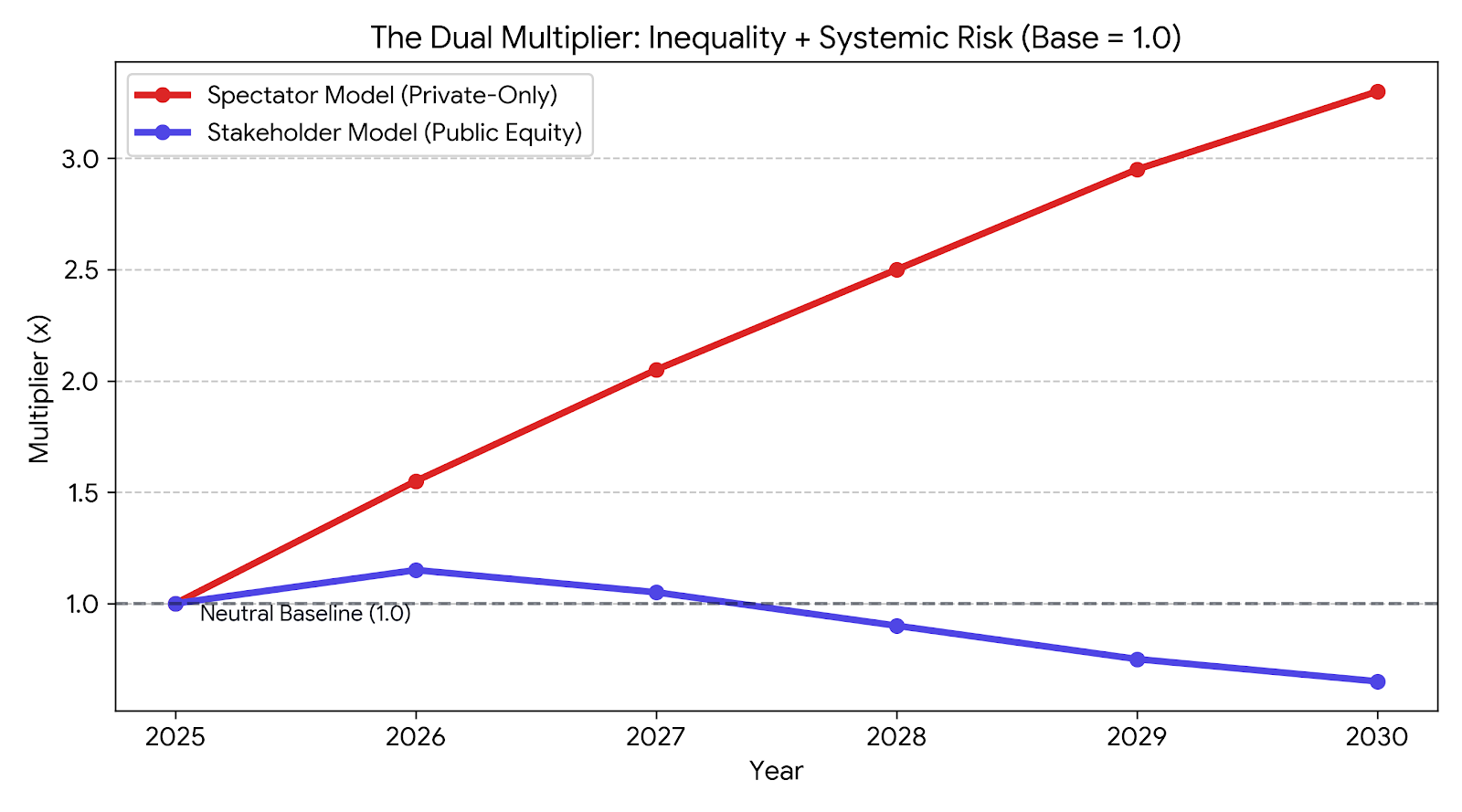
When we plug in baseline 2026 estimates (a starting US Gini coefficient of 0.41, private returns outpacing societal returns, and high concentration/disruption factors), the result is jarring:
Part 3: The Flip — Architecting the Public Equity Line
The key difference here is that AI is no longer speculative vaporware—it is proven technology beyond doubt. Large language models are deployed at scale with billions of daily users. Inference and training infrastructure is generating real revenue. The productivity gains are highly measurable.
That makes the case for a general public strategy compelling: citizens as voluntary investors with skin in the game. We propose flipping governments from sidelined spectators into active investors through citizen-directed mechanisms:
- Voluntary Checkoff Funds as Seed Capital: Expand the proven tax checkoff model, allowing citizens to redirect a small portion of their taxes to a public AI equity fund. To ensure fiscal discipline, we propose reasonable caps: a $10 maximum per taxpayer per year, and a total fund cap of $5–$10B annually.
- Windfall Clauses as Public Equity: Incentivize AI labs to include binding windfall clauses (e.g., 10–20% of breakthrough profits redistributed). The public fund invests via these mechanisms, making citizens shareholders with aligned returns.
- Blended Sovereign Funds: Partner public checkoff money with private capital in hybrid funds to derisk AI infrastructure for lower-income regions while earning equity to fund public reinvestment.
This is by no means suggesting we restrict or limit large private investments—quite the opposite. Private capital should continue driving speed, risk-taking, and breakthroughs at full throttle. This is a parallel "and" strategy, not an "or." Nor is this socialism: it's citizens voluntarily choosing to invest in a proven technology, with skin in the game, exactly how they invest in stocks or mutual funds.
Part 4: Modeled Impact ($100B+ Public Returns by 2030)
What happens when we apply standard venture mathematics to a public checkoff fund?
If just 10% of US taxpayers opt-in at a $5 average, it generates a $1.5B to $2B annual fund. If that fund invests 50% of its capital into AI equity (targeting a conservative 20% IRR) and 50% into public-good safety grants, the public prosperity growth (Pt) looks like this:
Public Prosperity Growth
- Pt: Public prosperity at time t (e.g., fund value for reinvestment).
- Re: Equity return rate (estimated at 0.20 or 20%).
- Fa: Annual fund inflow (estimated at $2B).
- Ci: Inequality concentration factor (estimated at 0.20 to account for administrative friction).
The 2026–2030 Result: The public fund grows to $12B+ by 2030, generating $2B to $3B a year in pure public returns. Scaled globally, this mechanism creates a $100B+ cumulative war chest for dividends, job retraining, and UBI pilots. The inequality multiplier drops by 20% to 30%, while systemic risk exposure is actively diluted through diversified public stakes.
| The AI Stance | Current: The Spectator | Proposed: The Stakeholder |
|---|---|---|
| Public Role | Reactive Regulator / Taxpayer | Proactive Equity Participant |
| Innovation Impact | Creates friction & slows speed | Parallel lane; zero private friction |
| Wealth Distribution | Highly concentrated in top 5% | Direct public dividends & grants |
| Systemic Risk | Society absorbs all labor shocks & debt bubbles | Diversified stakes stabilize the system |
Reflection: From Spectator to Stakeholder
The ugly truth of AI funding is clear: exclusive private lines create concentrated wins, deep inequality, and extreme systemic risk. Governments can flip to an investor role—using voluntary checkoffs as equity access—to derisk the boom and make prosperity visible to citizens.
This approach isn't anti-private or socialist; it's an "and/or" architecture. Private speed stays full throttle, while public funds create a parallel lane for safety, equity, and stability. With over $3 trillion in AI infrastructure spend projected by 2028, governments cannot afford to stay sidelined. We must architect this equity line now, or the inequality divide will become a permanent feature of the modern economy.
Book a complimentary 30-minute fit call to discuss how we can help you architect the inversion, or send me a DM on LinkedIn.